China vs the World: A Quick Comparison
China remains the largest producer of carbon fiber frames globally by volume, thanks to massive factory scale, strong raw material access, and a deeply embedded supply chain. But it’s not alone:
- Taiwan still dominates high-end OEM for major brands (e.g., Giant, Merida, Cervélo)
- Europe (Italy, Germany, Poland) is investing in boutique and automated production
- Vietnam, Cambodia, and Indonesia are absorbing mid-tier production for U.S. and Japanese brands avoiding China tariffs
- United States hosts a few niche players (e.g., Allied, Enve), mostly for high-end domestic builds
However, China remains the global leader when it comes to price-to-performance output, especially in the DIY and factory-direct segments.
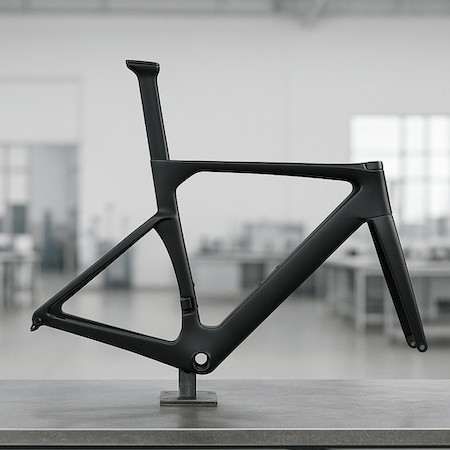
How Carbon Frames Are Made in China
Most Chinese factories use one of two molding technologies:
- EPS Molding (Expanded Polystyrene): A solid internal mold technique used for clean, wrinkle-free carbon layups. Typically found in frames from Carbonda, Miracle, and ICAN.
- Latex Bladder Molding: A flexible bladder expands during curing. Still common in lower-cost frames and widely used with success.
Frames are usually built using Toray T700, T800, or T1000 fibers, with variable resin systems. Internal cable routing, disc brake mounts, and proprietary aero shaping are now standard across even entry-level models.
Most Chinese carbon brands operate on an OEM/ODM basis—manufacturing frames for international labels while also producing unbranded or lightly branded versions for AliExpress, Alibaba, or direct-to-consumer sales.
Production Timelines & Scale
One of China’s major advantages is speed and volume. Small batch orders (1–5 frames) from vendors like TanTan or Carbonda typically ship in 2–4 weeks. Larger OEM runs can be completed within 30–60 days, depending on paint and QC requirements.
Automation is gradually entering the picture, but most carbon layup work is still done by hand—especially on lower-volume or complex aero frames. Labor remains affordable and skilled in key regions like Xiamen, Shenzhen, and Dongguan.
Advantages of Carbon Manufacturing in China
- Vertically integrated supply chain — carbon fiber, resin, and hardware often sourced domestically
- High output at low cost — unmatched price-to-performance ratio
- Rapid prototyping — new molds or geometries can be sampled quickly
- Direct-to-consumer agility — small orders, custom paint, and responsive service
These advantages explain why more riders are turning to Chinese frames—even after 2025 tariff adjustments. For custom builds, the value is hard to beat.
Disadvantages & Industry Challenges
- Brand trust and consistency — wide variance between factories
- Intellectual property concerns — copycat designs are still common
- Limited marketing and support infrastructure — warranties vary and documentation is often sparse
- Tariffs and global regulation — U.S. and EU trade policy adds cost and uncertainty
While quality has improved, buyers still need to vet vendors carefully. Reviews, community feedback, and frame-specific threads remain essential tools for navigating the market.
What’s Next for Chinese Carbon Manufacturing?
The future is likely to bring more:
- Automated layup and robotic tooling for large production runs
- High-end branded DTC platforms emerging from current OEMs
- Carbon fiber recycling and sustainability efforts driven by global pressure
- Even more regional diversification as trade tensions shape supply chains
China’s leading vendors are already adjusting by improving communication, tightening QC, and emphasizing high-end EPS designs. While boutique European carbon builders focus on ultra-premium offerings, China is positioned to dominate the mid-high tier DTC space globally—if they continue to evolve.
Learn More
Final Thoughts
Carbon frame manufacturing in China is no longer the secret it once was. With scalable factories, competitive tech, and decades of experience behind them, Chinese vendors are now defining the value segment of the global cycling industry.
For riders who care about performance, customization, and cost control, China remains the world’s most compelling carbon manufacturing zone. The trick, as always, is knowing which vendors to trust—and how to build smart.